First Blog Post
Corporate
News
Founder
Hypa Thetical
Jan 9, 2026

Why Billboards Still Win in the Southeast
The Southeastern U.S. is one of the most misunderstood advertising regions in the country. It’s often described as “regional,” “secondary,” or “flyover-adjacent,” yet the data tells a very different story. For brands looking to build scale, trust, and cultural relevance, billboard advertising across the Southeast consistently punches above its weight.
A Region Built for Reach
The Southeast includes some of the fastest-growing metros in the U.S., including Atlanta, Nashville, Charlotte, Raleigh-Durham, Tampa, Orlando, Austin-adjacent corridors, and South Florida. Collectively, the region accounts for tens of millions of residents and an even larger volume of daily commuters and visitors. Several Southeastern states have outpaced the national average for population growth over the past decade, driven by migration, job creation, and affordability relative to coastal markets (U.S. Census Bureau).
That growth shows up where billboards live: highways, arterials, and dense commuter corridors. The Southeast is car-centric, and Americans who drive regularly are exposed to billboards at some of the highest frequencies of any media channel (OAAA). For brands that need scale without fragmentation, that matters.
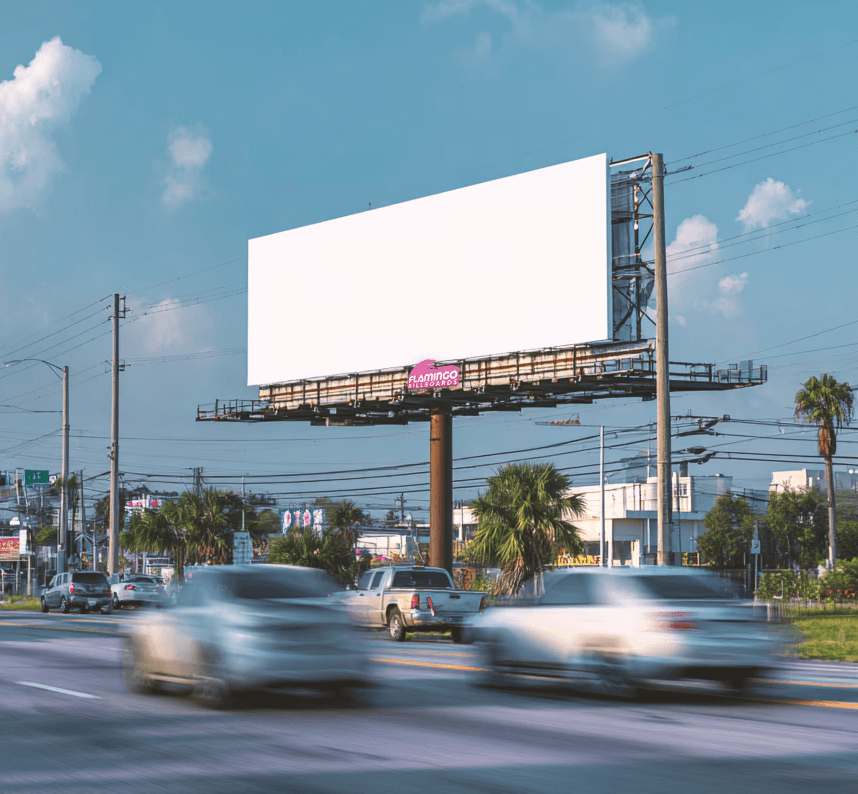
Conceptual rendering of Flamingo Billboard ad unit.
Trust Is a Real Advantage
Trust has become one of the hardest things for brands to earn, especially in regions where audiences are skeptical of overly polished or overly targeted digital advertising. Out-of-home consistently benefits from being part of the real world rather than interrupting it.
Recent industry research shows that consumers rate billboards as more trustworthy than many digital ad formats, particularly social media ads (Harris Poll / OAAA). In the Southeast, where community, familiarity, and local presence still carry weight, physical visibility helps brands feel established rather than opportunistic.
A billboard simply exists where people live their lives. That distinction matters more than most dashboards capture.
Cultural and Economic Diversity, Not Fragmentation
Another advantage of the Southeast is its diversity of audiences within shared physical spaces. You’re not advertising into isolated micro-markets. You’re reaching commuters, families, students, tourists, retirees, and remote workers often on the same roads, every day.
Major Southeastern metros also serve as regional hubs. Atlanta’s airport alone handles over 100 million passengers annually (Hartsfield-Jackson ATL), and cities like Orlando, Miami, and Nashville attract year-round tourism. Billboard placements in these markets routinely reach locals and visitors at once, increasing the efficiency of every impression.
Cost Efficiency That Actually Scales
Compared to New York, Los Angeles, or San Francisco, the Southeast offers significantly lower CPMs for large-format OOH while maintaining high frequency and dwell time (OAAA). That creates room for longer campaigns, heavier weight, or broader coverage without inflating budgets.
For growth-stage brands, this is especially attractive. You can test creative, establish presence, and scale visibility without needing to over-optimize every single impression. Billboards reward clarity and confidence.
Built for Brands That Want to Be Seen
The Southeast U.S. is a foundational market for brand-building. Billboards work here because the infrastructure, movement patterns, and cultural norms all support repeated, high-attention exposure.
For brands looking to grow regionally, or nationally from the ground up, billboard advertising in the Southeast remains one of the most practical ways to turn awareness into familiarity and familiarity into trust.
And in advertising, trust still does a lot of heavy lifting.